

Table of Contents
- Why Buying Discounted Women's Footwear Online Requires Caution
- How to Spot Fake Shoe Websites Before You Buy
- Safe Payment Methods for Online Retail Shoe Shopping
- How to Check Return Policies for Online Shoe Stores
- Verifying Authenticity and Brand Legitimacy
- Finding Quality Discounted Footwear That Actually Lasts
- Conclusion
Last Updated: August 20, 2026
Why Buying Discounted Women's Footwear Online Requires Caution
Counterfeit footwear costs the legitimate shoe industry billions annually, and many of those fakes end up in unsuspecting customers' shopping carts. When you buy discounted women's footwear online safely, you're navigating a marketplace where legitimate bargains sit alongside knockoffs, returns from other retailers, and products with hidden defects. The difference between a genuine deal and a costly mistake often comes down to knowing what red flags to watch for before you click purchase.
At Bargain Warriors LLC, we help budget-conscious shoppers find authentic discounted women's footwear online without the risk. The stakes matter: a pair of shoes that falls apart after two weeks isn't a bargain, no matter how low the price. Poor-quality footwear can cause foot pain, blisters, and long-term damage. That's why we've compiled this guide to help you shop with confidence.
The reality is straightforward, many online retailers selling discounted footwear operate legitimately, but others exploit the discount category to move questionable inventory. Your job is to distinguish between them before your money changes hands. This guide covers the specific safeguards that separate smart shopping from risky purchasing.
How to Spot Fake Shoe Websites Before You Buy
A fake shoe website might look polished on the surface, but specific details reveal its true nature. Start with the URL itself, legitimate retailers use secure connections (https://) with a visible padlock icon in your browser's address bar. If the site uses http:// without the "s," your payment data travels unencrypted. Never enter payment information on an unsecured site.
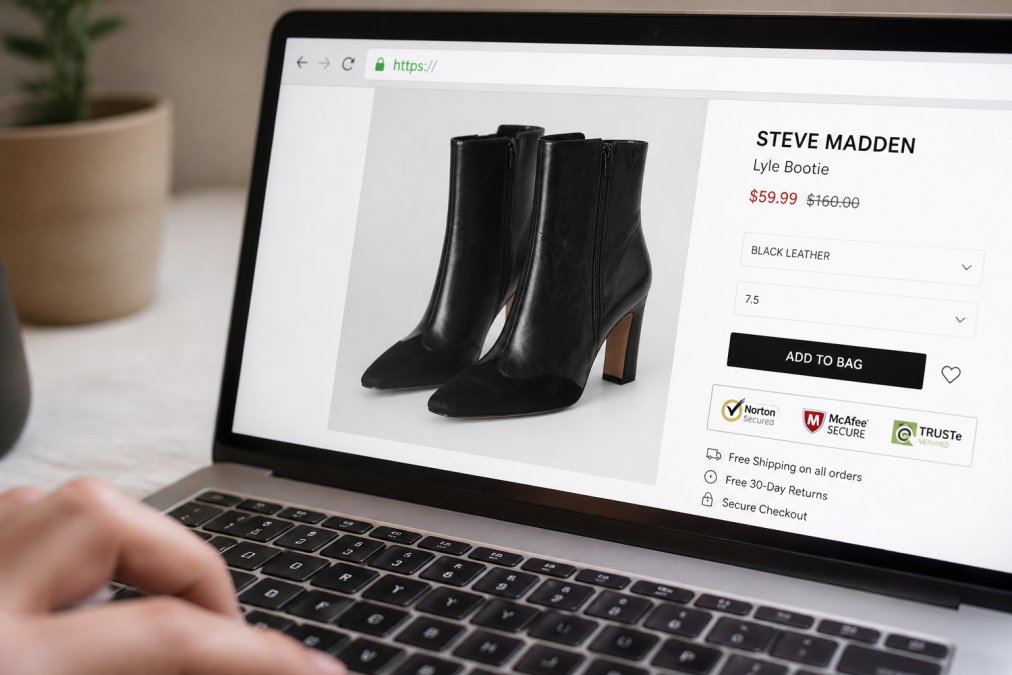
Next, examine the website's design and copy. Legitimate retailers invest in professional layouts, clear product photography, and grammatically correct descriptions. Fake sites often feature poor image quality, awkward phrasing, or text that's been machine-translated. Look for phrases that sound unnatural or descriptions that don't match the product images. A real shoe retailer knows their inventory; a fake one copies descriptions carelessly.
Check the contact information. Legitimate retailers display a physical address, phone number, and email. Call the number if you're uncertain, does someone answer? Is there a real business behind it? Fake sites often list only an email address or provide contact forms that never generate responses. Research the business address using Google Maps. If the address doesn't exist or belongs to a residential area, that's a warning sign.
Review customer feedback across independent platforms. Don't rely solely on reviews on the retailer's own website, those can be fabricated. Search the company name plus "reviews" on Google, check Better Business Bureau ratings, and look for mentions on social media. Legitimate retailers have consistent feedback across multiple platforms. If you find dozens of complaints about counterfeit products or non-delivery, move on.
Examine the product images carefully. Counterfeit shoe websites often use stolen photos from legitimate retailers. Try a reverse image search on Google Images, right-click a product photo and select "Search Image with Google." If that exact image appears on multiple unrelated websites, the photo is likely stolen. Legitimate retailers photograph their own inventory.
Safe Payment Methods for Online Retail Shoe Shopping
Your payment method determines your protection level when something goes wrong. Credit cards offer the strongest fraud protection, federal law limits your liability to $50 if unauthorized charges appear, and most card issuers waive even that. When you dispute a charge with your credit card company, the burden shifts to the merchant to prove the transaction was legitimate. This protection is crucial when buying discounted women's footwear online.
Debit cards provide weaker protection. While federal law still limits liability, the dispute process takes longer, and your money is temporarily removed from your account during the investigation. Avoid debit cards for online purchases when possible.
Digital payment services like PayPal add a layer of protection between you and the retailer. PayPal's buyer protection policy covers items that don't arrive or don't match the description. You can file a dispute directly with PayPal, which investigates independently. This is particularly valuable for discounted footwear purchases where the authenticity question is central.
Never use wire transfers, gift cards, or cryptocurrency for online shoe purchases. These payment methods offer no fraud protection and no way to recover your money if the seller disappears. Scammers specifically request these payment types because they're irreversible.
Before entering payment information, verify the checkout page is secure. Look for the padlock icon in your browser's address bar and confirm the URL begins with "https://" (not "http://"). Some retailers display security badges from companies like Norton or McAfee, hover over these badges to verify they're genuine, not images the scammer created.
Consider using a virtual credit card number for online purchases. Many credit card issuers allow you to generate temporary card numbers with spending limits. If the retailer's system is compromised, the virtual number can't be used elsewhere. This adds friction to the purchase process but maximizes security.
How to Check Return Policies for Online Shoe Stores
Before you complete your purchase, read the return policy thoroughly. This is where many discounted footwear retailers hide unfavorable terms. Legitimate retailers clearly state their return window, restocking fees, and who pays for return shipping.
A reasonable return policy allows returns within 30 days of purchase with free return shipping. Some retailers offer 60 days, which is even better. If the policy limits returns to 14 days or less, you're working with a tight window. Shoe fit issues often don't become apparent until you've worn them several times, so shorter return windows create real risk.
Check whether the retailer charges restocking fees on returned footwear. A 15-20% restocking fee is common in the industry, though some retailers waive it. If the retailer charges 30% or more, that's aggressive. For discounted footwear, restocking fees eat into the savings quickly, a $30 shoe with a 20% restocking fee costs you $6 to return.
Verify who pays for return shipping. The best policies include a prepaid return label. Some retailers require you to pay shipping, which can cost $8-15 depending on the shoe's weight. If you're buying a $25 pair of shoes and return shipping costs $12, you've lost half your savings. Factor this into your decision.
Look for the retailer's policy on final sale items. Many discounted shoe retailers mark certain products as final sale, meaning no returns accepted. If the item you want is final sale, you're accepting the risk that it won't fit or meet your expectations. Final sale discounts should be deeper to justify this risk.
Check the condition requirements for returns. Most retailers require shoes to be unworn with original tags attached. Some accept lightly worn shoes. If the policy requires shoes to be in mint condition, understand that even trying them on indoors might disqualify a return if the soles show any wear.
Verifying Authenticity and Brand Legitimacy
Counterfeit footwear has become sophisticated. Surface-level inspection isn't enough, you need to know what authentic shoes look like. Start by visiting the brand's official website and examining product images. Compare the shoe you're considering to the official photos. Look for differences in stitching patterns, logo placement, material texture, and overall construction quality.
Check the shoe's serial number or authenticity code. Many designer and premium brands include codes inside the shoe or on tags. Visit the brand's official website to learn how to verify these codes. Some brands provide online verification tools, enter the code and the system confirms whether it's authentic.
Examine the packaging. Authentic shoes come in branded boxes with consistent printing quality, proper labeling, and protective materials inside. Counterfeit packaging often features misspelled text, inconsistent colors, or low-quality printing. The box should feel substantial and well-constructed.
Research the retailer's relationship with the brand. Contact the brand's customer service and ask whether the retailer is an authorized seller. Legitimate brands maintain lists of authorized retailers. If the retailer isn't on that list, you're buying from an unauthorized channel, which increases counterfeit risk.
For discounted women's footwear, understand why the discount exists. Legitimate reasons include end-of-season clearance, overstock, or minor cosmetic imperfections. Suspicious reasons include "too good to be true" pricing or vague descriptions like "closeout inventory." Ask the retailer directly why the shoes are discounted. A straightforward answer (e.g., "last season's inventory") is reassuring. Evasive answers warrant caution.
Check the shoe's construction details. Authentic footwear features consistent stitching, even gluing, and precise alignment of design elements. Counterfeit shoes often have loose threads, uneven stitching, or misaligned logos. Examine photos closely or request additional images from the retailer before purchasing.
Finding Quality Discounted Footwear That Actually Lasts
The lowest price isn't always the best value. A $20 shoe that lasts three months costs more per wearing than a $40 shoe that lasts two years. When shopping for discounted women's footwear online, evaluate durability indicators to ensure your purchase delivers real value.
Material quality matters significantly. Leather and suede footwear typically outlast synthetic materials, though quality varies within each category. Full-grain leather resists creasing and ages well. Bonded leather (scraps glued together) deteriorates quickly. When examining product descriptions, look for specific material information. "Genuine leather" is better than "synthetic." "Full-grain leather" is better than "genuine leather."
Construction method affects longevity. Welted construction (where the sole is stitched to the upper) allows for sole replacement and extends shoe life. Glued soles are cheaper to manufacture but harder to repair. Cemented construction is the most common in discounted footwear, it's adequate but not ideal for long-term wear.
Examine the sole thickness and material. Thicker soles provide better cushioning and last longer. Rubber soles outperform synthetic materials. Cork-filled insoles mold to your foot over time and provide better support than flat insoles. These details appear in product descriptions if you read carefully.
Check reviews specifically for durability mentions. Customers often comment on how long shoes last. If multiple reviewers mention the shoes holding up well after six months or a year, that's a positive signal. Conversely, if reviewers mention soles separating or uppers tearing quickly, avoid that product.
Consider the shoe category. Athletic and performance shoes from established brands hold value better than trendy casual styles. Classic designs last longer than fashion-forward shoes that date quickly. When buying discounted women's footwear online, prioritize timeless styles in durable categories.
At Bargain Warriors LLC, we curate discounted footwear selections to balance price with quality. Our Steve Madden collection includes options like the Lyle black leather boots at $40 and the Nexie slouch block heel boots at $30. These designer options provide authentic quality at genuine discounts. We also stock the knee-high boots and over-the-knee styles, each at $30, offering variety for different occasions and preferences.


When you choose discounted footwear from a retailer committed to quality verification, you're protecting your investment. Authentic designer shoes at legitimate discounts deliver the value equation that makes budget shopping worthwhile.
Conclusion
Buying discounted women's footwear online safely requires vigilance, but the process becomes straightforward once you know what to verify. Secure websites, credit card payments, clear return policies, and authenticity checks form your protection framework. The challenge is that legitimate bargains exist alongside counterfeits and low-quality inventory in the same marketplaces. Your responsibility is distinguishing between them before purchase.
Bargain Warriors LLC simplifies this process by pre-vetting discounted footwear selections. We verify authenticity, confirm quality standards, and maintain transparent return policies so you shop with confidence. When you buy discounted women's footwear online through our platform, you're accessing genuine designer options like Steve Madden boots at prices that reflect real savings, not counterfeit shortcuts. Shop now and experience the difference authentic discounts make.
Frequently Asked Questions
What are the signs of a fake online shoe store?
Fake shoe websites often have poor grammar, blurry product photos, missing contact information, and unrealistic prices. Check for an SSL certificate (padlock icon in the address bar), legitimate business address, clear return policy, and customer reviews on independent sites. Legitimate retailers display security badges and have professional website design. Be suspicious of sites offering designer shoes at 80% off or claiming inventory that seems too good to be true.
What payment methods are safest for buying discounted women's footwear online?
Credit cards offer the strongest fraud protection under federal law. Use cards with purchase protection and dispute resolution. PayPal and digital wallets like Apple Pay add a security layer by keeping your card details private from the retailer. Avoid wire transfers, gift cards, or direct bank transfers, these cannot be reversed if the order never arrives or the shoes are counterfeit. Always shop on secure checkout pages (look for the padlock icon).
How do I verify if an online footwear retailer is legitimate before buying?
Search the retailer's name plus 'reviews' and 'complaints' on independent review sites. Check their business registration and physical address using the Better Business Bureau. Look for clear contact information, professional customer service, and transparent policies. Verify that designer brands are authorized retailers, most major brands list approved sellers on their websites. Read recent customer reviews specifically about shipping, quality, and returns, not just product ratings.
What should I look for in a return policy when buying discounted shoes online?
Check the return window (at least 30 days is standard), whether returns are free or cost you shipping, and if the retailer accepts returns on clearance or discounted items. Some retailers restrict returns on final-sale items, so read carefully. Verify the return process is simple, legitimate sites provide prepaid shipping labels or easy return instructions. Avoid retailers with vague policies or those that require returning items within 7-14 days. Always screenshot or save the policy before checkout.
This article was written using GrandRanker