

Table of Contents
- Why Some Cheap Clothes Fall Apart (And Others Don't)
- The 7-Point Quality Check for Any Garment
- How to Tell if Fabric Is High Quality Before You Buy
- Signs of Poor Garment Construction to Watch For
- How to Shop for Affordable Fashion Online Without Getting Burned
- Calculate Cost-Per-Wear Before You Checkout
- Final Check: Your 60-Second Quality Routine
- Frequently Asked Questions
Last Updated: September 5, 2026
Fast fashion has trained us to expect clothing that disintegrates after a handful of washes. But the truth is that price alone rarely determines durability, and learning how to spot cheap fashion quality is a skill that saves real money over time. This guide breaks down the exact tests you can run in a store or at home to judge cheap fashion quality before you hand over your cash.
The 7-point system below covers fabric, stitching, hardware, and finishing. It takes about 60 seconds to run through once you know what to look for, and it applies whether you are browsing a discount rack or inspecting an online order the moment it arrives. By the end, you will be able to predict with reasonable confidence whether a garment will survive its first season or fall apart by the third wash.
Why Some Cheap Clothes Fall Apart (And Others Don't)
The difference between a bargain and a waste of money usually comes down to fiber content rather than brand name. Natural fibers like cotton, linen, and wool breathe better and often hold their shape longer, while synthetic materials such as polyester and nylon can feel smooth initially but may pill or retain odors. A garment's fiber blend determines its tensile strength, which is the fabric's ability to resist tearing and stretching under pressure.
A common mistake is assuming that all low-cost clothing uses the same materials. In reality, a budget retailer can source a dense cotton twill that wears beautifully, while a mid-priced label might use a thin polyester blend that snags on the first wear. The label tells you what you are getting, but the fabric hand, how the material feels between your fingers, reveals whether the textile composition is genuinely durable.
The 7-Point Quality Check for Any Garment
Run these seven checks in order, and you will catch most construction and material flaws before they cost you money. Each test takes seconds but targets a specific failure point that cheap manufacturing routinely cuts corners on.
Fabric Feel and Weight
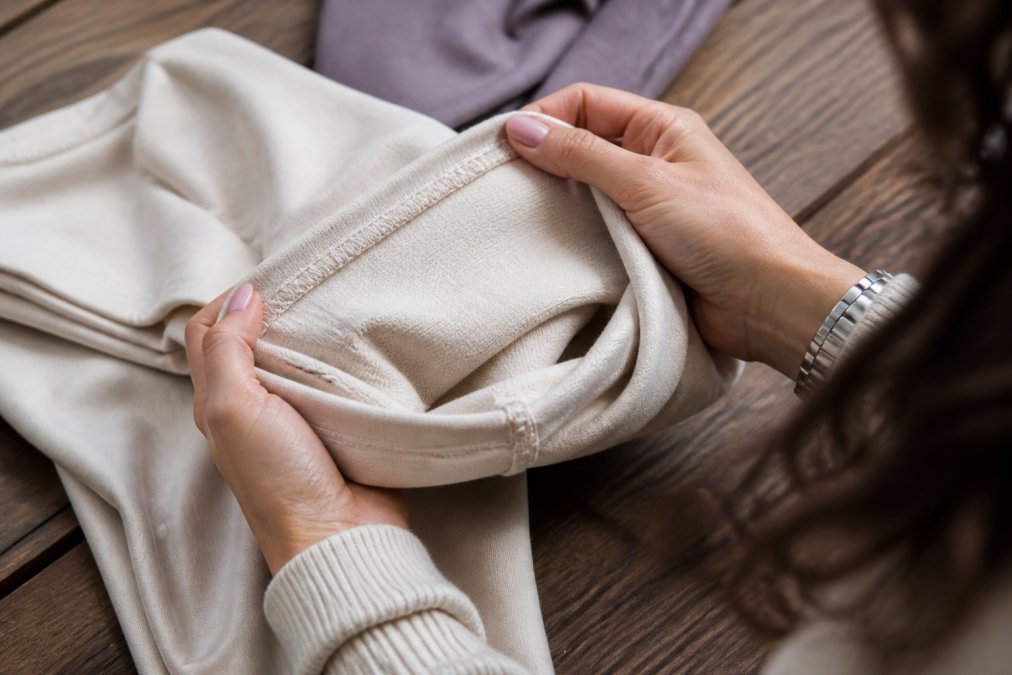
Fabric weight is your first clue to longevity. Hold the garment up and feel its density; a heavier fabric generally indicates more fibers per square inch, which translates to better durability. Lightweight, sheer materials may be fine for summer layers, but they often lack the structural integrity needed for everyday wear.
Check the opacity by holding the fabric up to a light source. If you can see through a supposedly opaque cotton shirt, the weave is too loose. A tightly woven fabric should feel smooth, not flimsy, and should resist being pulled apart when you tug gently at the edges.
Stitch Density and Seam Allowance
Turn the garment inside out and examine the seams. Quality garments use a stitch density of roughly 8 to 12 stitches per inch; if you can easily count individual stitches, the seam is too loose and will likely pop under stress (peer-reviewed research). Look for serging or overlocking on raw edges, which prevents fraying, and check that the seam allowance, the fabric between the stitch and the edge, is at least half an inch wide.
A narrow seam allowance of a quarter inch or less means the garment cannot be let out or repaired easily, and it will fray faster. Run your finger along the inside of the seam; it should feel smooth, with no skipped stitches or loose threads that signal rushed garment construction.
Buttons, Zippers, and Hardware
Hardware durability separates a quality garment from a disposable one. Buttons should be firmly attached with thread that has been wrapped several times, creating a small shank that allows the button to sit properly. Plastic buttons that feel thin and brittle will crack within a few washes, while natural materials like corozo or shell hold up far better.
Zippers deserve special attention. Pull the zipper up and down several times; it should move smoothly without catching or snagging. Check that the zipper teeth are made of metal or a sturdy nylon coil, not cheap plastic that will break. Look at the zipper pull and the stitching around it, since reinforcement at stress points indicates a manufacturer that cared about durability.
Pattern Matching and Print Alignment
Pattern matching is a reliable indicator of quality because it is expensive to do correctly. When a manufacturer cuts fabric for a plaid, stripe, or check pattern, aligning the print at the side seams and pockets wastes material. Cheap garments skip this step, resulting in mismatched lines where the front and back panels meet.
Check the side seams, the pocket openings, and the center back seam. If the pattern flows continuously across these junctions, the manufacturer invested in proper cutting. If the lines are visibly off, you are looking at a garment produced with cost-cutting in mind, and other corners were likely cut too.
The Wrinkle and Stretch Recovery Test
This test predicts how a garment will behave after hours of wear. Crumple a handful of fabric in your fist for about ten seconds, then release it. High-quality fabric with good wrinkle recovery will bounce back with minimal creasing, while cheaper materials will hold deep wrinkles that require ironing.
For stretch fabrics, gently pull the material and observe how it recovers. A quality knit should snap back to its original shape immediately. If it stays stretched out or develops a permanent baggy area, the elastic fibers are weak, and the garment will lose its shape after a single wearing.
Lining and Hem Finishing
A properly lined garment feels substantial and drapes well, but the lining itself reveals quality. Check that the lining is attached securely at the hem and armholes, and that it is made of a breathable material rather than cheap, static-prone polyester. The lining should not be visible from the outside when the garment is worn.
Hem finishing matters for longevity. A quality hem is either blind-stitched, leaving a nearly invisible line on the outside, or neatly top-stitched with even spacing. A hem that is simply folded and glued, or stitched with loose, uneven threads, will unravel quickly. Look for reinforcement at stress points like the crotch seam of pants or the underarm of a jacket.
Colorfastness and Dye Saturation
Colorfastness determines whether your garment bleeds onto other clothes in the wash. Dye saturation refers to how deeply the color penetrates the fibers. A quick test involves rubbing a damp white cloth against the fabric; if significant color transfers, the dye job is poor, and the garment will fade or bleed.
Deep, saturated colors are harder to achieve than pale ones, so a rich black or vibrant red at a low price point is either a great find or a sign that cheap, unstable dyes were used. Check for bubbling or a sticky feeling on printed designs, which indicates the print will crack and peel after a few washes.
How to Tell if Fabric Is High Quality Before You Buy
The fastest way to tell if fabric is high quality is to examine the fiber content on the care label and then verify it with touch. A care label that lists 100% cotton, linen, or wool is a good starting point, but the weave and weight determine whether that fiber was used well. Compare the fabric to a garment you already own and trust; the difference in density and smoothness is immediately obvious.
Consider the fiber blend carefully. A cotton-polyester blend can offer the best of both worlds, with cotton's breathability and polyester's wrinkle resistance, but the ratio matters. A blend with more than 50% polyester may trap heat and pill over time. According to guidance from the Federal Trade Commission on textile labeling, manufacturers must list fiber content accurately, so the label is a reliable starting point for your assessment.
Signs of Poor Garment Construction to Watch For
Several red flags signal poor garment construction before you even reach the fabric test. Crooked hems, where the bottom edge dips unevenly, indicate careless cutting. Misaligned buttonholes that do not line up with the buttons themselves are a classic sign of rushed assembly. Puckering along seams, where the fabric bunches or ripples, suggests the tension was wrong during sewing.
Check the collar and cuffs on shirts, since these areas require precise tailoring details. A collar that does not lie flat or cuffs that gap when buttoned are difficult to fix and will always look off. Look for loose threads at the seams and unfinished edges; while a single stray thread is not a dealbreaker, multiple loose threads signal a lack of quality control on the production line.
How to Shop for Affordable Fashion Online Without Getting Burned
Online shopping removes your ability to touch the fabric, which makes the quality check harder. The most effective strategy is to read the product description for fabric composition and then look at customer photos, which show the garment in real lighting rather than staged studio shots. Search for reviews that mention the fabric weight and whether the item runs sheer or thin.
Pay close attention to the return policy before you buy. A generous return window gives you the chance to run the 7-point check at home and send the item back if it fails. When you shop with a retailer that stands behind its products, you reduce the risk of losing money on a low-quality impulse buy. Bargain Warriors LLC structures its catalog around value, but the same inspection rules apply whether you are buying from us or anywhere else.
Calculate Cost-Per-Wear Before You Checkout
Cost-per-wear is the most honest way to evaluate whether a garment is worth its price. Divide the purchase price by the number of times you realistically expect to wear it. A $30 shirt worn twice is a $15-per-wear disaster, while a $60 dress worn thirty times costs just $2 per wear.
This framework changes how you view cheap fashion quality. A $15 pair of shoes that falls apart after ten wears costs $1.50 per wear, while a $50 pair that lasts two years of weekly use costs about $0.48 per wear. The more expensive option is actually the bargain. Use this calculation to justify spending more on staples like coats and boots, and to feel good about saving on trendy pieces you will only wear a handful of times.
| Item Type | Price | Expected Wears | Cost-Per-Wear | Verdict |
|---|---|---|---|---|
| Trendy top | $15 | 5 | $3.00 | Skip, too expensive per wear |
| Quality jeans | $60 | 120 | $0.50 | Buy, excellent value |
| Cheap shoes | $20 | 10 | $2.00 | Skip, poor durability |
| Winter coat | $120 | 200 | $0.60 | Buy, long-term staple |
Final Check: Your 60-Second Quality Routine
Before you commit to any purchase, run this quick routine. First, check the care label for fiber content and note any red flags like high polyester in a garment meant for daily wear. Second, feel the fabric weight and examine the garment inside out for seam quality and serging. Third, test the zipper and buttons, then crumple the fabric to check wrinkle recovery.
The final step is the cost-per-wear calculation, which forces you to think about longevity rather than the initial price tag. This 60-second routine catches the majority of quality issues, and it gets faster with practice. When you find pieces that pass all seven checks, they are worth holding onto, even if they cost a bit more upfront.
Smart shopping is about knowing where to save and where to invest. When you are browsing for affordable fashion, apply these tests to every piece, and you will build a wardrobe that lasts without emptying your wallet. For guidance on sustainable shopping habits, resources like the EPA's guide on reducing textile waste offer practical advice on extending the life of your clothing.
Building a durable wardrobe on a budget is a challenge, but it is one you can win with the right approach. Bargain Warriors LLC helps you find quality footwear, fashion accessories, and everyday essentials at prices that respect your budget, so you can apply these quality checks without overspending. Explore our wide selection of products and significant discounts on regular retail prices, and step out in style with confidence. Shop now and put your new skills to work.
Frequently Asked Questions
What is the 3-3-3 rule for clothing?
The 3-3-3 rule is a shopping guideline that suggests you should be able to style a new piece in at least 3 different outfits, that it should be comfortable enough to wear for 3 hours, and that it should be versatile enough to wear in 3 different seasons. It helps you avoid impulse buys that end up hanging unworn in your closet, which is a common trap when shopping for cheap fashion.
How do you describe poor quality clothes?
Poor quality clothes typically show signs of poor garment construction: loose or uneven stitching, frayed seams, thin fabric that feels almost see-through, and hardware that feels flimsy. The fabric might pill after one wash, colors may fade quickly, and zippers often snag. You can often spot these issues by holding the garment up to light to check opacity.
How can you spot cheap fashion quality when shopping online?
When shopping online, you can't feel the fabric, so look for detailed photos showing close-ups of seams, buttons, and fabric texture. Read reviews that mention quality and durability. Check the fabric composition in the description. When you receive the item, do the wrinkle test and check the stitching immediately. Shopping with a retailer that has a clear return policy reduces your risk.
Why do some affordable clothes last longer than others?
The difference often comes down to fabric choice and garment construction rather than the price tag. A $20 dress made from a dense cotton with reinforced seams can outlast a $100 dress made from cheap polyester with minimal seam allowance. Look for natural fibers or quality synthetic materials, check stitch density, and consider the cost-per-wear calculation: a slightly more expensive item that lasts for years is often the better deal.
This article was written using GrandRanker