

Table of Contents
- The Reality Behind Online Discount Prices
- How Retailers Use Dynamic Pricing and Algorithms
- Hidden Costs of Online Shopping That Erase Savings
- How to Spot Fake Online Discounts and Inflated Markdowns
- Price Comparison Tools for Online Shopping
- Online vs. In-Store: Where You Actually Save Money
- The BOPIS Pricing Paradox and Mobile vs. Desktop Gaps
- Conclusion
Last Updated: August 23, 2026
The Reality Behind Online Discount Prices
Whether online discount prices are actually cheaper depends on what you're comparing, how retailers calculate discounts, and what hidden costs appear at checkout. Many online retailers use "price anchoring", displaying a crossed-out original price next to a sale price to make discounts look bigger than they are. That original price might never have been the real market rate. A jacket listed as "originally $120, now $60" could have been priced at $60 for months before the fake markdown appeared (the FTC).
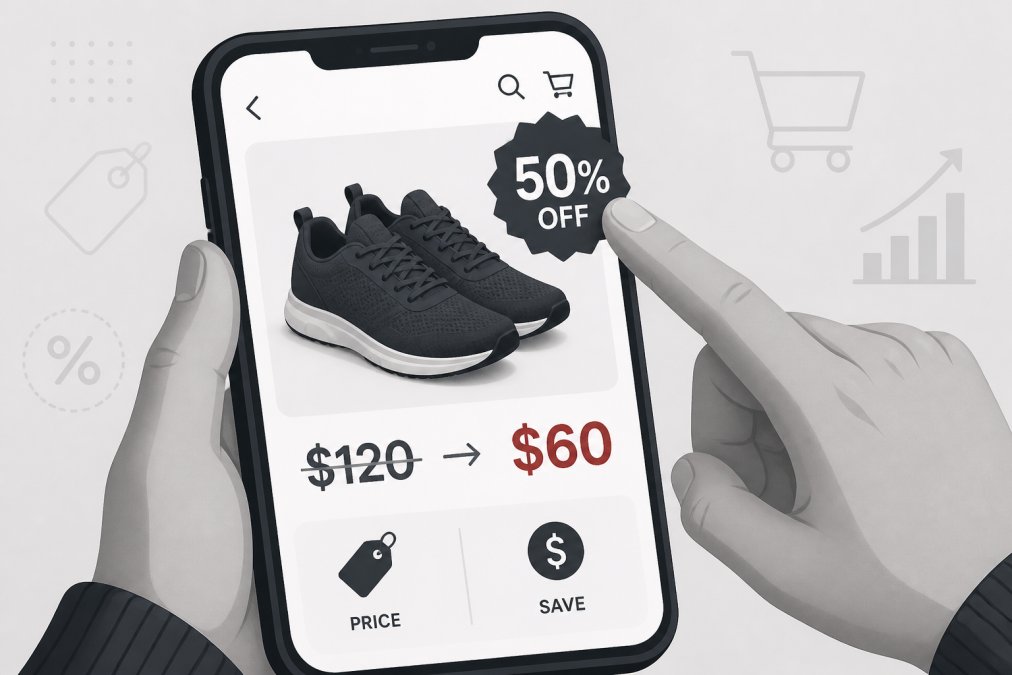
When your brain sees a 50% discount, it triggers an emotional response that overrides rational comparison shopping. But if the base price was inflated to begin with, you're not actually saving anything. The best online deals aren't always better than in-store prices, and sometimes they're worse once you factor in everything.
How Retailers Use Dynamic Pricing and Algorithms
Retailers use algorithms that adjust prices based on demand, inventory levels, browsing history, and dozens of other factors. This practice, called dynamic pricing, means the price you see might be completely different from what another shopper sees.
Your browsing history plays a role. If you've visited a product page multiple times, the algorithm might raise the price slightly, assuming you're more likely to buy. Conversely, if you're a new visitor from a price-comparison site, you might see a lower price designed to convert you.
Inventory management feeds into pricing too. When stock is high, prices drop. When inventory runs low, prices climb. Mobile vs. desktop pricing can also differ, some retailers test different prices on mobile users versus desktop users. Timing matters as well; retailers know when shoppers typically browse and buy, and some use slightly higher prices on weekends.
Federal Trade Commission guidance on pricing practices requires retailers to be transparent about their pricing, but the rules focus on deceptive practices rather than algorithmic adjustments. Dynamic pricing itself is legal as long as it doesn't discriminate based on protected characteristics.
Hidden Costs of Online Shopping That Erase Savings
You found a 40% discount on shoes. Add shipping, and your savings drop to 25%. Add tax, and you're down to 15%. Add a restocking fee if you need to return them, and your "great deal" might cost more than buying in-store.
Shipping costs are the biggest hidden expense. Free shipping often means the retailer built the cost into the product price. A shoe that costs $40 with free shipping might cost $30 in-store. Some retailers charge $7-$15 per order, which easily wipes out a small discount.
Sales tax varies by state and sometimes by county. Return shipping is where many shoppers get burned, "free returns" often means you're paying for return shipping out of pocket, typically $7-$12 per return. Restocking fees are less common but still happen, with some retailers charging 15-20% of the purchase price for final sale or clearance items.
Always calculate the total checkout amount, which is almost always higher than the advertised price.
How to Spot Fake Online Discounts and Inflated Markdowns
Check the price history using browser extensions or price-tracking tools to see what an item actually cost over the last 30-90 days. If the "original price" is higher than anything that tool shows, the discount is fake.
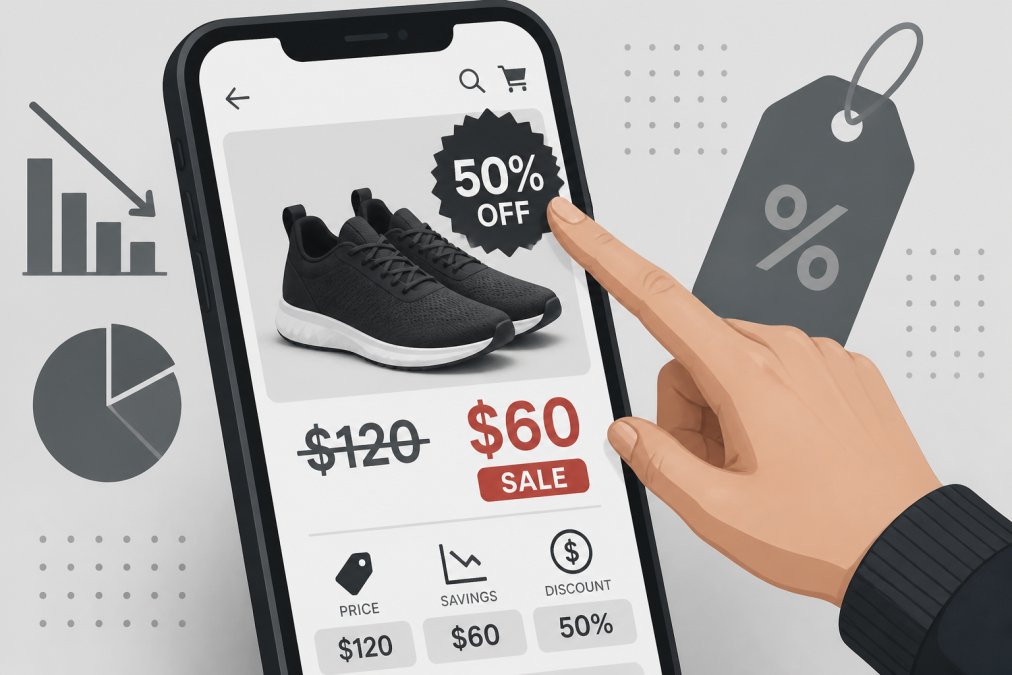
Look for round-number discounts. A 50% discount is suspicious. A 47% discount looks more authentic because it suggests a real calculation rather than a made-up markdown. Check the base price against competitors, search the product name on three other sites. If every retailer is selling the same item at the same "sale" price, that's probably the actual market rate, not a discount.
Read the fine print on "original prices." Some retailers display manufacturer's suggested retail price (MSRP), not their own historical price. MSRP is often inflated and rarely represents what anyone actually pays. Watch for clearance tactics, items marked as "clearance" or "final sale" are often overstocked or slow-moving, not necessarily bargains.
Compare the total checkout price, not the advertised price. Add shipping, taxes, and any fees to the listed price. That's your real cost.
Price Comparison Tools for Online Shopping
Price-tracking extensions like Honey and Rakuten monitor prices across retailers and alert you when items drop. They also apply coupon codes automatically at checkout.
Camelcamelcamel tracks price history on Amazon specifically, showing you a graph of price changes over months or years. If a price drops 5% after being stable for six months, that's real. If it "drops" 40% right after a fake price increase, that's manipulation.
Google Shopping lets you filter by price and sort results from lowest to highest, showing prices from multiple retailers at once. Retailer price-match policies can work in your favor, many big-box retailers will match competitor prices if you bring proof.
Browser extensions that find coupon codes are helpful but not foolproof. RetailMeNot and similar sites aggregate coupon codes, but not all codes work, and some are expired. Always test a code before committing to a purchase.
Consumer Reports guide to online shopping safety provides additional tips on verifying retailer legitimacy and protecting yourself from scams while price shopping.
Online vs. In-Store: Where You Actually Save Money
Fashion and accessories often have better prices online because online retailers have lower overhead. You're not paying for physical store space, staff, and utilities.
Seasonal items see different dynamics. Online retailers often discount seasonal items more aggressively because they need to clear inventory before the season ends. Grocery and household essentials are trickier, Amazon and Walmart offer competitive prices online, but local grocery stores sometimes run better deals on specific items.
Pet supplies show a clear online advantage. Pet stores have high markups, and online retailers compete aggressively. Bulk items like cat litter and dog food are significantly cheaper online. Electronics are competitive across channels, with real savings coming from finding the lowest price regardless of channel.
Return policies matter for the total cost comparison. In-store returns are free and instant. Online returns cost money and time. Membership programs change the equation, Costco and Sam's Club offer bulk discounts that online retailers can't match for members. Target Circle and Walmart+ offer discounts that narrow the gap.
The BOPIS Pricing Paradox and Mobile vs. Desktop Gaps
Buy Online, Pick Up In Store (BOPIS) creates a strange pricing situation. Some retailers show different prices for BOPIS versus home delivery. Check both options before deciding. A $50 item with free BOPIS might cost $45 for home delivery with a $7 shipping fee, bringing the total to $52.
Mobile shopping prices sometimes differ from desktop prices. A few retailers test pricing strategies by showing different prices on mobile devices versus computers. If you're shopping on mobile and the price seems high, try checking on desktop.
App-exclusive deals are another layer. Retailers sometimes offer better prices in their mobile app than on their website. If you're shopping on a retailer's website on your phone, switch to their app and see if the price drops.
Clearing your cookies before shopping sometimes shows different prices. Location services on your phone can influence pricing too, some retailers use geolocation data to adjust prices based on local competition.
Conclusion
Are online discount prices actually cheaper? Sometimes. The real answer is that you need to look beyond the advertised discount and calculate the true total cost. Factor in shipping, taxes, return fees, and the actual price history of the item. Compare across multiple retailers and channels. Use price-tracking tools to verify that discounts are real.
At Bargain Warriors LLC, we believe smart shopping means understanding where real savings come from. Our wide selection of products at unbeatable prices is built on transparent pricing. When you shop with us, the price you see is the price you pay, with straightforward shipping and return policies. Start exploring our inventory today to find deals you can actually trust.
=== FAQ ANSWERS (audit these too, same rules) ===
[1] Q: Is online shopping actually cheaper than buying in-store? A: Not always. Online discount prices look cheaper until you add shipping, taxes, and return fees. In-store purchases eliminate shipping costs entirely. The real answer depends on the specific item, retailer, and whether you factor in hidden costs. Price comparison tools help clarify the true checkout total across channels.
[2] Q: How can I verify if an online discount is legitimate? A: Check the product's price history using browser extensions or price tracking sites to see if the 'original' price was artificially inflated. Compare the sale price across multiple retailers. Legitimate discounts typically appear on multiple platforms; isolated deep discounts on unknown sites are often fake. Always verify the base price before the markdown was applied.
[3] Q: What hidden costs should I watch for when shopping online? A: Beyond the listed price, watch for shipping fees, sales tax (which varies by state and retailer), restocking fees on returns, and expedited delivery charges. Some retailers charge differently for BOPIS (Buy Online, Pick Up In-Store) versus home delivery. Always review the checkout total before finalizing your purchase, that's your actual cost.
[4] Q: Do retailers change prices based on my browsing history or device? A: Yes. Retailers use algorithms to adjust prices based on browsing behavior, device type, and location. Mobile users sometimes see different prices than desktop users for the same item. Clear your cookies, use incognito mode, or shop from a different device to see if prices fluctuate. Price matching policies can help you secure the lower rate if you find a discrepancy.
Frequently Asked Questions
Q: Is online shopping actually cheaper than buying in-store?
A: Not always. Online discount prices look cheaper until you add shipping, taxes, and return fees. In-store purchases eliminate shipping costs entirely. The real answer depends on the specific item, retailer, and whether you factor in hidden costs. Price comparison tools help clarify the true checkout total across channels.
Q: How can I verify if an online discount is legitimate?
A: Check the product's price history using browser extensions or price tracking sites to see if the 'original' price was artificially inflated. Compare the sale price across multiple retailers. Legitimate discounts typically appear on multiple platforms; isolated deep discounts on unknown sites are often fake. Always verify the base price before the markdown was applied.
Q: What hidden costs should I watch for when shopping online?
A: Beyond the listed price, watch for shipping fees, sales tax (which varies by state and retailer), restocking fees on returns, and expedited delivery charges. Some retailers charge differently for BOPIS (Buy Online, Pick Up In-Store) versus home delivery. Always review the checkout total before finalizing your purchase, that's your actual cost.
Q: Do retailers change prices based on my browsing history or device?
A: Yes. Retailers use algorithms to adjust prices based on browsing behavior, device type, and location. Mobile users sometimes see different prices than desktop users for the same item. Clear your cookies, use incognito mode, or shop from a different device to see if prices fluctuate. Price matching policies can help you secure the lower rate if you find a discrepancy.
This article was written using GrandRanker