

Table of Contents
- Start With Your Measurements: An Online Shoe Sizing Guide
- How to Check Shoe Material Quality From Photos
- Read the Reviews for Real-World Feedback
- Look for Clear Photos of the Outsole and Footbed
- Check the Return Policy Before You Commit
- Where to Find Affordable Women's Footwear for Daily Wear
- Spotting Quality Shoes Online: Red Flags to Avoid
- Conclusion: Your Next Steps to Buying Quality Shoes Online
- Frequently Asked Questions
Last Updated: September 8, 2026
Learning how to find quality shoes online comes down to one skill: reading a product listing like an expert instead of an optimist. When you shop from a screen, you cannot feel the leather or test the arch support, so you have to verify quality through measurements, photos, and policies. This guide walks through a practical checklist that separates genuine footwear from cleverly photographed disappointments.
Start With Your Measurements: An Online Shoe Sizing Guide
A proper online shoe sizing guide begins with your feet, not the product page. The most common reason an online shoe purchase fails is a size mismatch, and the fix is measuring with a repeatable method.
How to Measure Your Feet at Home
Measure both feet at the end of the day when they are slightly swollen, standing with your weight distributed evenly. Use paper taped to a hard floor, a wall as a backstop, and a ruler or Brannock device. Trace each foot, then measure two dimensions:
- Length: From the back of the heel to the tip of the longest toe (which is not always the big toe).
- Width: Across the widest part of the ball of the foot.
Record both numbers in inches and centimeters. Your feet are rarely identical, so use the larger foot as your baseline. If the difference exceeds a quarter size, order a half size up and use an insole or heel grip on the smaller foot.
Why Brand Size Charts Are Not Interchangeable
Sizing varies between manufacturers and even between models from the same brand. A size 8 in one brand can feel like a 7.5 in another, especially with boots or pointed heels, because shoe lasts differ by brand, style, and country of origin.
Quality retailers publish detailed charts with US sizes and centimeter or inch footbed measurements. When a listing provides only generic sizes without a measurement reference, treat it as a red flag. Cross-reference the brand's chart with the retailer's, as they do not always match.
Measure the Footbed, Not Just the Label
A size label tells you the nominal size, but the actual footbed length determines fit. Many quality listings include the footbed measurement in centimeters. Compare that to your foot length plus a thumb's width of allowance (roughly 0.4 to 0.6 inches) for wiggle room.
Width and Volume: The Overlooked Variables
Most size charts only address length, but width and volume matter just as much. If you have wide feet, look for brands offering width options (C, D, E, EE) or known for a wider toe box. If the listing does not mention width, search reviews for "narrow," "wide," or "tight across the toes."
For high-volume feet (high instep), laced shoes or adjustable straps are safer than slip-ons or rigid-shaft boots. For low-volume feet, look for a padded tongue or a swappable insole.
The 3-Point Fit Check Before You Order
Before you click buy, run this check:
- Length: Your longest toe has at least a thumb's width of space from the end of the shoe.
- Width: The ball of your foot aligns with the widest part of the shoe, with no pinching.
- Arch: The shoe's arch support sits under the natural arch of your foot, not behind it or in front of it.
If the listing does not provide enough information to verify these three points, find a different listing or retailer. The goal is to verify, not guess.
How to Check Shoe Material Quality From Photos
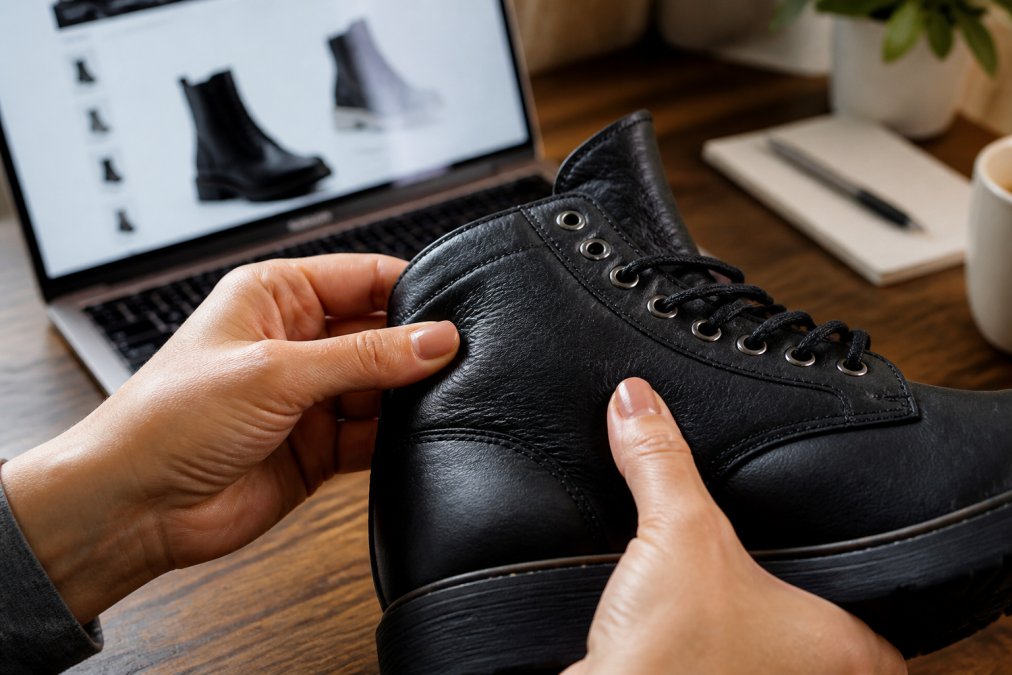
The material quality determines whether your shoes online will last one season or five, and you can assess it from photos. Genuine leather shows natural grain, texture variations, and creasing along flex points; synthetics look unnaturally smooth and uniform. Zoom into product images for visible pores and subtle imperfections that indicate real hide.
Stitching tells you just as much as the upper material. Quality shoes have tight, even stitches with no loose threads or skipped sections. Examine where the upper meets the sole and check whether the stitching is straight and consistent. The FTC's guide to understanding leather and textile labeling explains what terms like "genuine leather" and "man-made" actually mean, which helps you interpret product descriptions accurately.
Read the Reviews for Real-World Feedback
Customer reviews are your best window into how quality shoes online perform after the novelty wears off. Look past the five-star ratings and read the three and four star reviews, where buyers describe specific issues like narrow toe boxes, peeling lining, or soles that wear down quickly. Repeated complaints should be trusted.
For affordable women's footwear for daily wear, durability matters most. Search reviews for "weeks," "months," or "fell apart" to gauge longevity, and note sizing accuracy comments. A product with dozens of detailed reviews is safer than one with a few vague five-star ratings.
Look for Clear Photos of the Outsole and Footbed
Most listings show flattering angles, but the outsole and footbed reveal how the shoe is constructed. Quality manufacturers do not hide these details, so if the listing lacks them, treat that as a warning sign. The outsole should have visible tread patterns and substantial material, not thin foam.
The footbed matters for comfort and arch support. Look for cushioned insoles that appear removable or clearly padded, and check whether the listing mentions arch support or ergonomic design. A shoe with a flat, featureless footbed will likely leave your feet aching after a full day. The American Podiatric Medical Association's guidance on choosing footwear emphasizes that proper arch support and cushioning are essential for preventing foot pain, especially in shoes meant for daily wear.
Check the Return Policy Before You Commit
A generous return policy is the safety net that makes buying quality shoes online less risky. But the fine print holds the real rules, and the difference between a 30-day free return window and a "final sale" label is the difference between a calculated risk and a gamble.
What to Look For in a Return Policy
Before entering your payment information, find the return policy and read the fine print. Look for these five specifics:
- Return window: How many days from delivery do you have? Most quality retailers offer 30 days; some extend to 60 or 90. Fewer than 14 days is a warning sign.
- Return shipping: Who pays? Free return shipping is ideal. If you pay, factor that cost into the total price of the shoe.
- Condition requirements: Must the shoes be unworn with the original box? Some retailers accept lightly worn shoes; others reject anything with visible wear on the outsole.
- Restocking fees: A restocking fee of 10-20% can turn a "free returns" promise into a real cost. Check for this before you order.
- Refund method: Do you get cash back or store credit? Store credit locks you into that retailer, which may not be what you want if the shoe quality disappoints.
Navigating "Final Sale" Risks: A Practical Framework
Items marked final sale cannot be returned, so you are betting entirely on the accuracy of the listing and your size measurements. The risk is not just financial, it is the wasted time and frustration of owning unwearable shoes. Here is a framework to decide whether a final sale purchase is worth it:
Do buy final sale only if ALL of these are true:
- You already own the exact same brand and model (or a very close variant) and know your size in it.
- The listing includes detailed measurements (footbed length, width, heel height) that you can verify against your own foot measurements.
- The product has a substantial number of recent reviews (20 or more) that consistently confirm sizing and quality.
- The discount is significant enough (typically 40% or more off retail) to justify the risk.
Do not buy final sale if ANY of these are true:
- It is your first time buying this brand.
- The listing uses stock photos without detailed shots of the outsole, footbed, and stitching.
- The reviews are sparse, old, or mixed on sizing.
- You are between sizes or have a half-size foot that does not match the available sizes.
The Unboxing Inspection: Your Last Line of Defense
Even with a good return policy, the moment of truth is when the box arrives. Before removing tags or walking on the shoes, do a 5-point inspection:
- Check the box and packaging: Is the box damaged? Are the shoes wrapped properly? Quality retailers ship carefully.
- Inspect the uppers: Look for loose threads, uneven stitching, glue marks, or color inconsistencies between the left and right shoe.
- Examine the outsole: Is the tread pattern even? Are there any air bubbles or thin spots in the rubber?
- Feel the footbed: Press down on the insole. Does it have cushioning, or does it feel like a flat layer of cardboard?
- Walk on a soft surface: Take a few steps on carpet or a rug. Does the shoe slip at the heel? Do your toes hit the end? Does the arch feel like it is in the right place?
If anything fails this inspection and the item is not final sale, start the return immediately. Do not "break them in" and hope they improve, structural issues will not fix themselves. If the item is final sale and fails, contact the retailer anyway; some offer courtesy exceptions for manufacturing defects.
The Bottom Line on Return Policies
A retailer that stands behind its products will offer a reasonable return window, typically 30 days or more, and be clear about conditions. If the policy is buried, confusing, or full of exceptions, that signals how the retailer handles problems after the sale. The best protection is a thorough pre-purchase inspection and a disciplined final-sale framework.
Where to Find Affordable Women's Footwear for Daily Wear
Finding affordable women's footwear for daily wear that still meets quality standards requires knowing where to look and what to pay. Discount retailers and flash sale sites can offer genuine savings, but apply the same scrutiny as any other purchase. Check materials, read reviews, and verify the return policy before assuming a low price means a good deal.
At Bargain Warriors LLC, we offer a wide selection of high-quality products at unbeatable prices. For example, the Steve Madden "Lyle" black leather boots are available for $40.00, offering genuine leather construction and designer styling. Similarly, the Steve Madden Nexie Slouch Block Heel Boots bring sophisticated block heel comfort for $30.00, making them a smart pick for daily wear.


| Shoe Option | Price | Best For | Key Feature |
|---|---|---|---|
| Steve Madden Lyle Boots | $40.00 | Statement outfits | Genuine leather, cow fur tips |
| Steve Madden Nexie Boots | $30.00 | Casual to office | Block heel, slouch silhouette |
| Steve Madden Knee-High Boots | $30.00 | Cold weather layering | Sleek knee-high profile |
| Steve Madden Over the Knee Boots | $30.00 | Evening events | Soft-shell flexibility |
Spotting Quality Shoes Online: Red Flags to Avoid
Certain warning signs should make you pause before clicking buy. Stock photos appearing on multiple listings suggest the seller uses generic images rather than photographing the actual product. Blurry or low-resolution photos can hide material flaws. And if the description is vague about materials, saying only "imported" or "vegan leather" without specifics, the quality is probably low.
Authenticity is another concern when shopping discount sites. Counterfeit shoes not only violate trademarks but also tend to use inferior materials and construction. The USPTO's resources on spotting counterfeit goods outlines common signs of fakes, including inconsistent logos, misspelled brand names, and packaging that looks off. A reputable seller will clearly identify the brand and provide detailed product information.
Conclusion: Your Next Steps to Buying Quality Shoes Online
Buying quality shoes online does not require luck, just a consistent process. Measure your feet before every purchase, inspect materials and stitching in photos, read reviews for durability complaints, and verify the return policy before checkout. Apply these steps to every listing to dramatically reduce the chances of disappointment.
When you are ready to shop, Bargain Warriors LLC offers a wide selection of women's footwear at unbeatable prices, from designer boots to everyday styles. Our significant discounts mean you can access affordable fashion and lifestyle products without stretching your budget. Shop now and step out in style without breaking the bank.
Frequently Asked Questions
What should I look for when buying shoes online to ensure quality?
Focus on material descriptions like full-grain leather over vague terms such as 'vegan leather' or 'man-made materials.' Inspect photos for consistent stitching and check the outsole type. Reviews mentioning durability and comfort over time are strong signals of quality shoes online. Also, verify the return policy so you can exchange if the fit is off.
How do I spot fake or low-quality footwear on retail websites?
Compare product photos against the brand's official site. Look for inconsistencies in logos, stitching, and packaging. Be wary of prices that are drastically lower than retail, as this can signal a counterfeit. Check for an authentic brand label in the images and read customer reviews that specifically mention authenticity or if the item looks like the photos.
Are online shoe reviews reliable for determining quality?
Yes, but focus on detailed reviews rather than star ratings alone. Look for comments about arch support, outsole durability, and how the shoe holds up after a few months of wear. Filter reviews by 'most recent' to gauge current quality, as manufacturing can change. A pattern of similar complaints is a more reliable indicator than a single negative review.
What return policies should I look for when buying shoes online?
Look for a free, easy return policy with at least a 30-day window. Ensure the site allows returns for wrong sizing, not just defective items. Check if you must pay for return shipping, as this can add to the cost. Avoid 'final sale' items unless you are certain about your size and the quality of the specific product.